

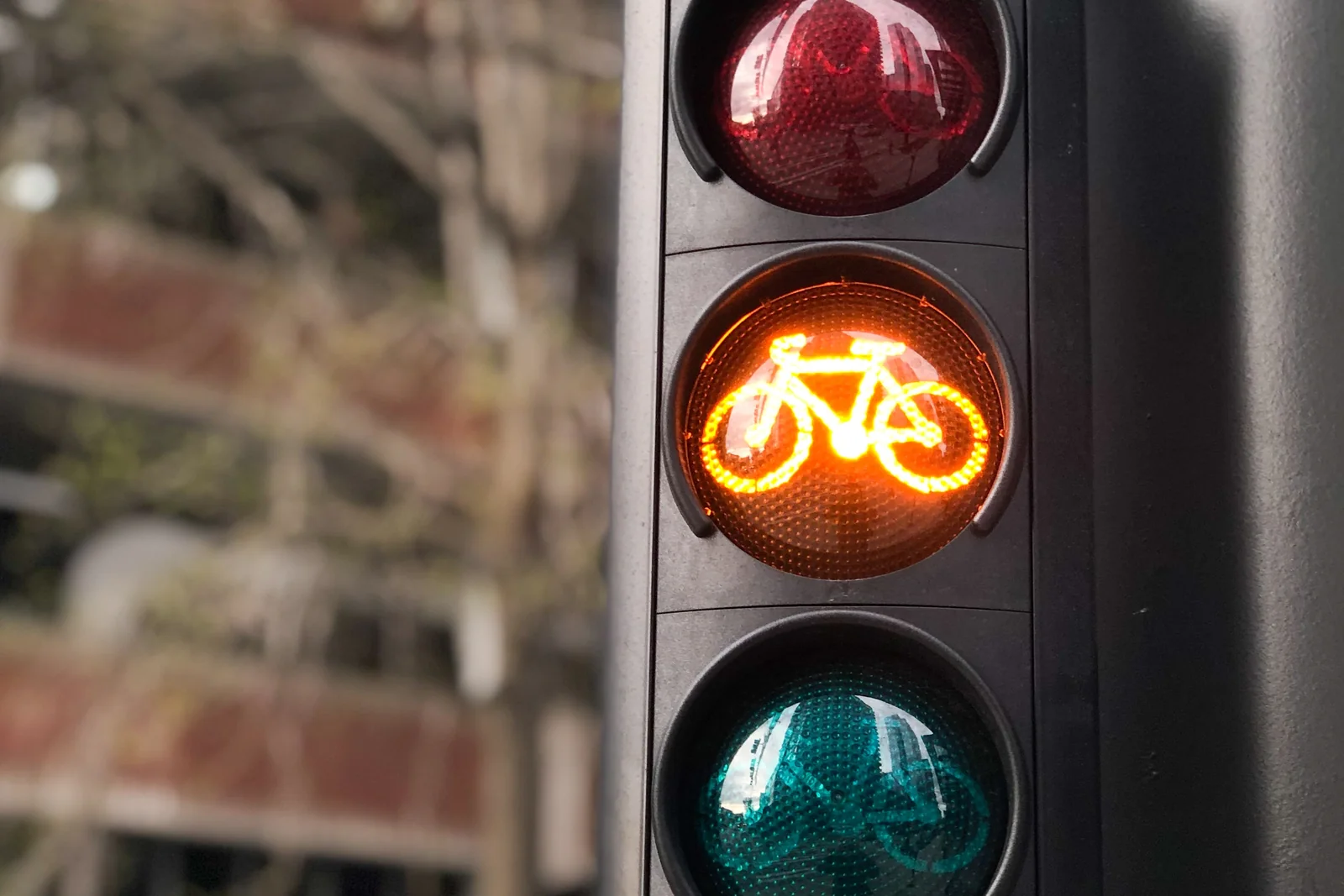
Usually not — though the answer depends on what actually happened at the intersection, not just on the stop sign.
RCW 46.61.190, Washington's stop-as-yield law (often called the "Idaho Stop"), permits cyclists to treat stop signs as yield signs. Rolling through a stop sign on a bicycle is a legal maneuver in Washington, with two exceptions: railroad crossings and stopped school buses. So when an insurer argues that the rolling stop itself makes you at fault, that argument loses most of its force against a statute that expressly permits the behavior.
Washington's Bicycle Stop-as-Yield Law
Washington permits a person riding a bicycle to treat many stop signs as yield signs, while preserving the duty to yield when traffic has the right of way.
Yielding Safely at Stop Signs
What the stop-as-yield law does not do is override the duty to yield. Treating a stop sign as a yield sign still means yielding — to traffic that has the right of way, before entering the intersection.
So the legitimate fault question in these cases is not whether the cyclist came to a complete stop. It is whether the cyclist yielded appropriately to traffic that had the right of way. If a car with the right of way was already entering the intersection and the cyclist failed to yield, that failure — not the rolling stop — is the real comparative fault issue, and it can be a serious one depending on the facts.
These are different questions. Adjusters routinely blur them, and the tactic works on people who do not know the statute exists.
How Stop-Sign Conduct Affects Comparative Fault
When an adjuster raises the stop sign, the response is that the behavior is not independently fault-creating under Washington law. Any comparative fault argument has to be grounded in the actual collision mechanics: what the cyclist could see, what they yielded to, where the other vehicle was, and how fast everyone was moving. Intersection geometry, sight lines, and witness accounts answer those questions — not whether a foot touched the ground.
Evidence That Establishes Right-of-Way
Washington law here protects cyclists from arguments that succeed in other states. In a jurisdiction with harsher fault rules, a stop sign violation could devastate a case. In Washington, the same behavior is permitted by statute, and the analysis moves to where it belongs: the right of way, and who actually had it.
Legal sources
General legal information only. Specific facts, policy language, parties, and deadlines can change the analysis.