

Seattle Bicycle Injury Resource
Washington Bicycle Injury FAQs
Twenty detailed answers covering roadway rights, bike lanes, passing, crosswalks, dooring, e-bikes, insurance, comparative fault, government claims and catastrophic injuries—with links to Washington statutes and appellate decisions. For a broader overview of liability, evidence, insurance, damages and deadlines, visit our bike accident injury page.
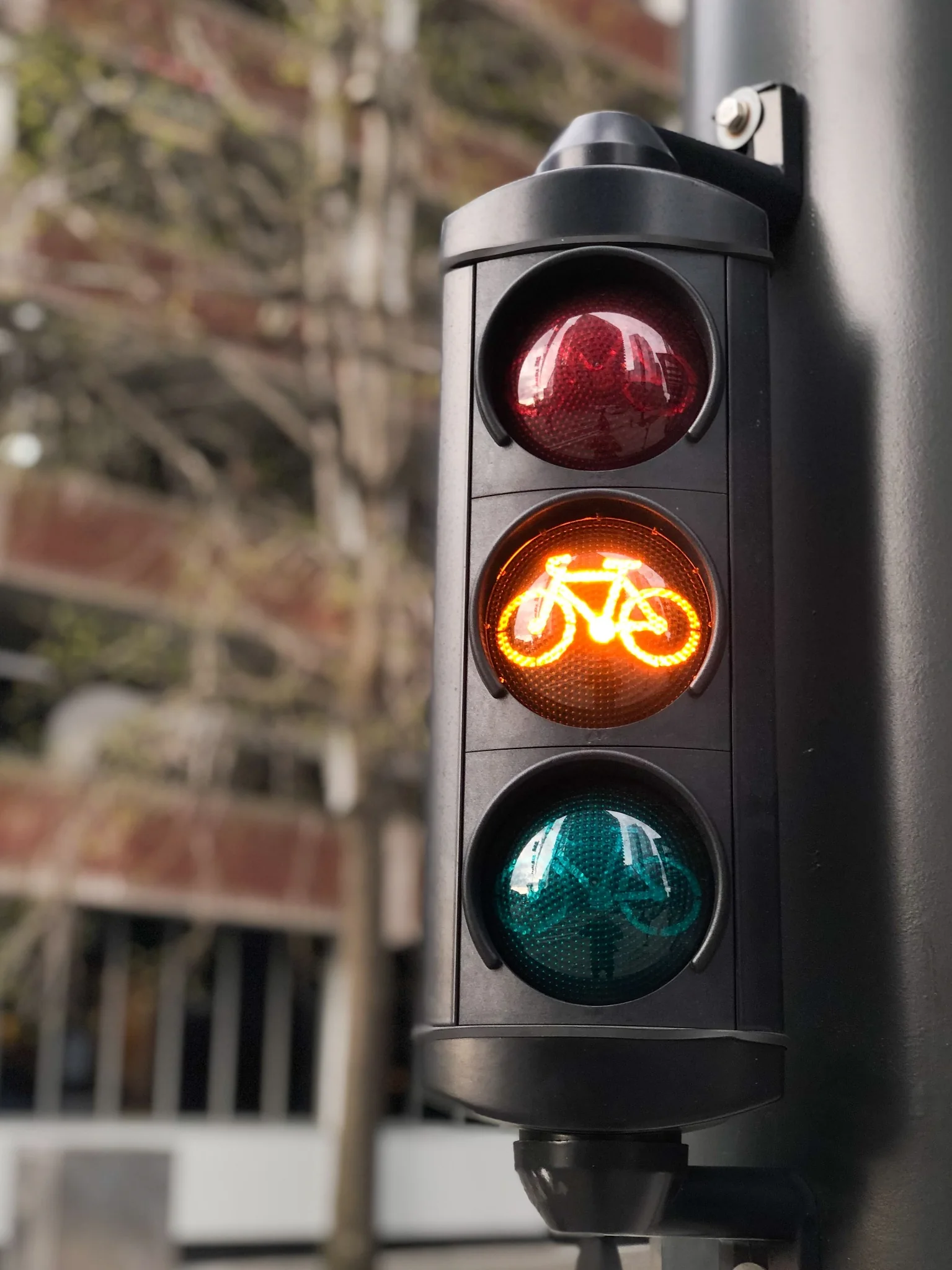
Fault and Washington Bicycle Laws
01 Do bicyclists have the same rights as drivers in Washington?
Generally, yes when riding on the roadway. Washington law gives a person riding a bicycle on a roadway the rights and duties that apply to drivers, except for bicycle-specific rules and vehicle rules that cannot logically apply to a bicycle. When a bicyclist rides on a sidewalk or in a crosswalk, Washington instead gives the rider the rights and duties of a pedestrian.
That distinction matters after a collision. A cyclist hit while riding in a traffic lane may rely on vehicle right-of-way, turning, passing and intersection rules. A cyclist riding through a crosswalk may rely on crosswalk protections, while still having duties such as not entering so suddenly that a nearby driver cannot safely stop.
A traffic citation is useful evidence, but Washington generally does not treat every traffic-code violation as automatic civil liability. Most statutory violations may be considered as evidence of negligence, and the civil case still turns on duty, breach, causation, damages and any comparative fault.
02 Do I have to ride in the bike lane or on the far right side of the road?
Not automatically. Washington law says a cyclist traveling slower than the normal flow of traffic should ride as near to the right side of the right through lane as is safe, but the statute contains important exceptions. A rider may move away from the right edge to turn, pass, avoid parked or moving vehicles, pedestrians, animals, debris, surface hazards and other unsafe conditions.
The law also says a cyclist may use a shoulder or a specially designated bicycle lane; it does not say a cyclist must use one in every circumstance. On a one-way road with at least two marked lanes, a cyclist may also ride as near to the left side of the left through lane as is safe.
This can be critical in injury cases because an insurer may argue that the cyclist should have been farther right. The actual statutory question is whether the rider's position was safe and reasonable under the conditions—not whether the rider hugged the curb regardless of parked cars, drainage grates, potholes or turning traffic.
03 How much space must a driver give when passing a bicyclist?
Washington's safe-passing law gives vulnerable road users specific protection. On a road with two or more lanes moving in the same direction, a motorist passing a vulnerable user generally must move completely into a lane to the left when it is safe to do so. On a one-lane road, when there is enough room to pass within the lane, the driver must reduce speed to a safe passing speed and pass at a safe distance—where practicable, at least three feet.
If there is not enough room to pass safely within the lane, the motorist may need to move into the oncoming lane when that maneuver can be made safely and legally.
A close pass can support a negligence claim even when there is no direct impact between the vehicle and bicycle. The important evidence may include video, eyewitnesses, scrape patterns, the cyclist's line of travel, lane width and whether the driver's maneuver forced the cyclist off the road or into another hazard.
04 Who is usually at fault in a right-hook bicycle collision?
A right hook occurs when a motorist turns right across the path of a bicyclist traveling in the same direction. Washington law does not create a one-sentence rule declaring one party automatically liable in every right-hook collision, but it does require a driver to make a turn only when the movement can be made with reasonable safety and to give the required signal. A cyclist lawfully using a roadway or bike lane also has the roadway rights Washington grants to bicyclists.
The facts matter: Was the cyclist already alongside the vehicle? Did the driver overtake and immediately turn? Was there a bike lane? Was the cyclist approaching from a sidewalk or crosswalk? Did the driver signal? Did either party have a traffic signal or other control?
Video from buses, businesses, traffic cameras or nearby vehicles can be especially valuable because right-hook cases often turn on timing and positioning in the final seconds before impact.
05 What if a driver turns left in front of a bicyclist?
Washington law requires a driver turning left within an intersection, or into an alley, private road or driveway, to yield to an oncoming vehicle that is already in the intersection or so close as to constitute an immediate hazard. Bicycles are expressly included in Washington's vulnerable-road-user framework.
A left-turn bicycle collision often raises questions about visibility, speed, distance, lighting, lane position and whether the driver genuinely had enough time to complete the turn safely. A cyclist's lawful presence in the roadway is not diminished simply because the vehicle is smaller or easier to overlook.
If a left-turn violation occurred, that statutory breach may be considered evidence of negligence in a civil case. It is not automatically the end of the analysis because Washington uses comparative fault and still requires proof that the violation caused the injuries claimed.
06 Do bicyclists have the right-of-way in marked and unmarked crosswalks?
A bicyclist using a crosswalk receives pedestrian rights and duties under Washington law. Drivers must stop and remain stopped for a bicycle crossing within a marked or unmarked crosswalk when the bicycle is upon or within one lane of the half of the roadway on which the vehicle is traveling or onto which it is turning.
There is an important limit: a bicycle cannot suddenly leave a curb or other place of safety and enter the path of a vehicle that is so close the driver cannot stop. In Seattle, a bicyclist riding through a crosswalk must also yield to pedestrians using that crosswalk.
An 'unmarked crosswalk' can exist at an intersection even without painted stripes. That is why a claim should not be dismissed simply because the collision occurred at an intersection without visible crosswalk paint.
07 Can I legally ride a bicycle on the sidewalk in Seattle?
Seattle generally allows bicycle riding on sidewalks and public paths, but the rider must operate carefully and prudently at a speed reasonable for the conditions. A cyclist must yield to pedestrians and give an audible signal before overtaking and passing a pedestrian.
Washington state law separately provides that a person riding a bicycle on a sidewalk or in a crosswalk has the rights and duties of a pedestrian. It also requires vehicle drivers to yield to pedestrians and bicycles on sidewalks.
Sidewalk-collision cases can be fact intensive because driveways, parking-garage exits and intersections create sight-line problems. Whether a cyclist was traveling at a reasonable speed for the sidewalk conditions can become a comparative-fault issue, while a driver exiting a driveway may have separate duties to yield before entering or crossing the roadway.
08 Who is responsible when a parked driver opens a door into a bicyclist?
Seattle's Traffic Code prohibits a person from opening a vehicle door on the side adjacent to moving traffic unless and until it is reasonably safe and can be done without interfering with traffic. That rule directly addresses classic 'dooring' collisions.
Dooring cases may involve more than the person who opened the door. Depending on the facts, issues can include whether the vehicle was lawfully parked, whether a passenger opened the door, whether a rideshare or delivery stop created an unusual hazard, and whether another party's conduct contributed.
Washington's Supreme Court has also addressed insurance coverage after a Seattle bicyclist was injured by an opened car door. In McLaughlin v. Travelers, the court held that Washington casualty-insurance law's definition of 'pedestrian' includes bicyclists and that the cyclist's medical-payment injuries were covered under the policy before the court.
09 Can bicyclists treat stop signs as yield signs in Washington?
Yes, in many ordinary situations. Washington's stop-sign statute allows a person operating a bicycle to either make a full stop or follow the rules that apply to a yield sign. That means slowing to a reasonable speed and stopping when safety requires it, while yielding to traffic that is in the intersection or approaching closely enough to be an immediate hazard.
There are exceptions. The bicycle stop-as-yield option does not replace the required stop at a railroad grade crossing or a school-bus stop signal.
This rule matters because a driver or insurer may casually say a bicyclist 'ran the stop sign' when the rider was legally permitted to treat it as a yield. The real questions are whether the cyclist slowed appropriately, yielded when required and entered only when the movement could be made safely.
10 What lights and equipment does Washington require on a bicycle at night?
During the hours of darkness, Washington requires a bicycle to have a white front lamp visible from at least 500 feet and a rear red reflector that meets the statute's visibility requirement. A red rear lamp or flashing LED taillight may be used in addition to the required reflector. The bicycle must also have a brake capable of making the braked wheels skid on dry, level, clean pavement.
A lighting violation does not automatically erase an injury claim. Under Washington law, most statutory violations are evidence of negligence rather than negligence per se. The defense would still need to connect the missing or inadequate light to the collision and the allocation of fault.
Evidence such as street lighting, vehicle headlights, reflective clothing, witness visibility, video and the driver's own statements can become important if visibility is disputed.
11 Is a bicycle helmet legally required in Seattle or King County, and can not wearing one destroy my claim?
King County repealed its all-ages bicycle-helmet requirement in 2022. The current Board of Health code states that the prior punitive helmet requirement was repealed while continuing to encourage helmet use.
Not wearing a helmet does not automatically make a bicyclist responsible for a collision. Washington is a comparative-fault state, and fault must be tied to conduct that legally contributed to the harm. A motorist who makes an unsafe turn or passes too closely does not become fault-free merely because the cyclist was unhelmeted.
In a head-injury case, however, defendants may still try to argue that helmet use is relevant to the extent of injury. Whether that evidence is legally admissible or causally persuasive depends on the facts, expert evidence and the issues before the court. The collision-causation question and the injury-severity question should be analyzed separately.
12 Do Washington bicycle laws apply to e-bikes?
Often, but the class and the location both matter, and the definition itself changed in 2026. Washington defines three classes of electric-assisted bicycle. Class 1 provides pedal assistance up to 20 mph; Class 2 can propel without pedaling up to 20 mph; Class 3 provides pedal assistance up to 28 mph and must have a speedometer.
The Legislature also narrowed the definition in 2026. A vehicle capable of exceeding 20 miles per hour on solely its electric motor, or one the manufacturer or seller designed to be easily configured out of compliance, is no longer an electric-assisted bicycle at all. The motorcycle and moped definitions may apply to it instead.
Where each class may ride still depends on local rules. Class 1 and Class 2 e-bikes may generally use shared-use paths and bicycle facilities, although local authorities can regulate them, and Class 3 faces tighter sidewalk and shared-use path restrictions. An e-bike injury claim should identify the exact device, its class, where the collision occurred and any applicable local rule rather than assuming every e-bike is governed identically. Our Washington E-Bike Injury FAQs cover the 2026 change and the Puget Sound local rules in detail.
Insurance Coverage and Medical Bills
13 Can I bring a claim if a pothole, dangerous trail condition or bad road design caused my bicycle accident?
Potentially. A dangerous-condition case may involve a city, county, the State, a private property owner, a contractor or another entity responsible for the location. Washington's Supreme Court has recognized the government's common-law duty to maintain roadways in a condition reasonably safe for ordinary travel, and in Camicia v. Howard S. Wright Construction Co. the court rejected an overbroad attempt to use recreational-use immunity merely because a transportation trail was also used recreationally.
These claims are very fact specific. Notice of the defect, how long it existed, prior complaints, maintenance records, construction plans, sight distance and whether the condition was reasonably discoverable can matter.
Government claims also have special procedures. Claims against local governments are subject to RCW 4.96.020, and claims against Washington State have their own presentment and waiting-period statutes. Evidence should be preserved quickly because a pothole, sign, pavement marking or construction zone can change immediately after an accident.
14 What if the driver who hit me leaves the scene?
Call law enforcement and report the collision as soon as reasonably possible. Washington requires a driver involved in an injury or death collision to stop, remain at the scene, provide identifying and insurance information and render reasonable assistance.
Insurance may also matter. Washington UIM coverage is designed to protect insured people who are legally entitled to recover damages from underinsured, hit-and-run and certain phantom vehicles, subject to the policy and statutory requirements. A phantom vehicle is one that causes injury or damage without physical contact; Washington requires corroborating evidence beyond the claimant's testimony and a law-enforcement report within 72 hours for that statutory category.
Video, witnesses, vehicle fragments, plate information, app data and nearby surveillance can be decisive in identifying the driver or satisfying coverage requirements.
15 Can my own auto insurance cover me when I am injured while bicycling?
It can. Washington casualty-insurance law defines a 'pedestrian' broadly as a natural person who is not occupying a motor vehicle. In McLaughlin v. Travelers Commercial Insurance Co., the Washington Supreme Court held that this insurance-code definition includes bicyclists and applied it to the medical-payment coverage at issue.
For a Washington auto policy, Personal Injury Protection (PIP) must be offered, although the named insured may reject it in writing. The statutory minimum option includes medical/hospital, funeral, income-continuation and loss-of-services benefits. UIM coverage is a separate coverage that may apply when the at-fault motorist is uninsured, underinsured, hit-and-run or a qualifying phantom vehicle.
Coverage still depends on the policy, household status, written rejections, exclusions and facts. A bicycle collision should trigger a review not just of the driver's liability policy but also the injured rider's own auto policies and potentially policies covering resident relatives.
Damages and Bicycle Claim Value
16 Can I still recover if I made a mistake on the bicycle?
Yes. Washington uses comparative fault. A claimant's own percentage of fault generally reduces compensatory damages by that percentage; it does not automatically bar recovery.
For example, a jury could find that a motorist made an unsafe turn while also finding that the cyclist's speed, lighting, lane position or other conduct contributed. The damages would then be adjusted according to the fault allocation.
Importantly, a traffic-code violation is usually evidence of negligence rather than automatic negligence. That applies to both sides. The analysis should focus on what each person actually did, which duties applied, whether any breach caused the collision and what percentage of responsibility is supported by the evidence.
17 How long do I have to file a bicycle-injury lawsuit in Washington?
Many Washington personal-injury claims are subject to a three-year limitations period under RCW 4.16.080, but that is not a safe reason to wait. The correct deadline depends on the type of claim, defendant, age and other facts.
Claims involving a city, county or other local government are also subject to a statutory tort-claim presentment process. Claims against Washington State have a separate claim form and a 60-calendar-day waiting period before suit may be commenced. Those procedures can interact with the limitations period.
Washington also tolls certain limitations periods for people who were under 18 when the claim accrued and for certain other statutory disabilities. Because missed deadlines can end an otherwise valid claim, limitations analysis should be done from the date of the incident rather than near the three-year mark.
18 What damages can be claimed after a serious bicycle collision?
A bicycle-injury claim can include the losses that were legally caused by the collision and can be proven with competent evidence. Depending on the case, that may include medical expenses, future medical care, lost income, diminished earning capacity, pain, disability, loss of normal activities and damage to the bicycle, electronics, clothing or other property.
The scope of damages depends on the injuries and proof. A fractured wrist with a short recovery is not valued the same way as a permanent neurologic injury, and a high-end bicycle should be documented with receipts, model information, photographs and repair or replacement evidence rather than treated as generic property.
Insurance limits can affect what is practically collectible, which is why liability coverage, UIM, PIP and additional responsible parties should be investigated early.
Evidence, Deadlines, and Special Defendants
19 What evidence should I preserve after a bicycle collision?
Preserve more than photographs of the damaged bicycle. Strong bicycle cases often depend on evidence that disappears quickly: helmet or handlebar-camera footage, nearby business video, bus video, traffic-camera material, vehicle event data, delivery or rideshare app records, witness contact information, 911 audio, body-camera footage, roadway measurements and the exact condition of signs, paint, debris or pavement.
Keep the bicycle, helmet, lights, clothing and damaged electronics in their post-collision condition until they can be documented. Avoid repairing or discarding critical physical evidence too early.
Medical records and wage documentation matter too. The legal claim is not only about who caused the collision; it must also connect the collision to the injuries and economic losses being claimed. A clean evidence timeline makes both causation and damages easier to evaluate.
20 What happens when a driver causes catastrophic injury or death to a bicyclist?
The civil and traffic/criminal consequences are separate. Washington statutes create specific vulnerable-user offenses when negligent driving proximately causes death, great bodily harm or substantial bodily harm to a vulnerable user such as a bicyclist. Those provisions can carry enhanced fines, license suspension and, for first-degree offenses, criminal penalties.
A civil claim may proceed independently to seek compensation for legally recoverable losses. If the cyclist dies, Washington's wrongful-death statute identifies beneficiaries who may benefit from the action, including a spouse, state-registered domestic partner, children and stepchildren, and, when none of those exist, parents or siblings.
The existence or outcome of a traffic or criminal case does not by itself determine every issue in the civil claim. Civil liability, comparative fault, insurance coverage and damages still require their own analysis.